LONGWELL Long-life Cross Flow Fan: Why Can It Run for Over 50,000 Hours?
For engineers, HVAC designers, and procurement managers, a fan failure is never just about a broken component. It is about system downtime, expensive emergency maintenance, and damage to brand reputation. Whether you are designing a trench heating system for a luxury hotel or a cooling unit for sensitive electronics, the reliability of your air movement components is non-negotiable.
You have likely seen specifications promising a “long lifespan,” but what does that actually mean in real-world applications? How do some fans fail after 10,000 hours while others, like the LONGWELL cross flow fan, continue to operate smoothly past the 50,000-hour mark?
The secret lies not in a single part, but in a holistic approach to engineering—combining advanced motor technology, precision bearing selection, and aerodynamic balance. In this guide, we will dismantle the engineering behind crossflow fan long lifespan, explore why DC crossflow fans often outlast their AC counterparts, and provide you with a comprehensive maintenance checklist to maximize the longevity of your ventilation systems.
What Actually Defines “Lifespan” in Industrial Fans?
Before we dive into the hardware, you need to understand the metrics used to measure longevity. It is not as simple as running a fan until it stops spinning.
Understanding L10 Life Expectancy
In the fan industry, lifespan is typically quantified using the L10 Life standard. This metric refers to the number of hours that 90% of a group of identical fans will survive under a specific load and speed before evidence of fatigue failure occurs.
For example, if a LONGWELL cross flow fan is rated for 50,000 hours L10 at 40°C (104°F), it means that after 50,000 hours of continuous operation, 90% of the tested units are still running perfectly. In reality, the average life (L50) is often much longer—sometimes double the L10 figure.
The Impact of Temperature on Survival
Temperature is the enemy of longevity. As a general rule of thumb in electronics and electromechanical devices, for every 10°C (18°F) rise in operating temperature, the life expectancy of the bearing grease is cut in half.
This is why selecting a fan designed for efficient heat dissipation is crucial. A fan that runs cool naturally lasts longer. This brings us to the core reason why premium fans outperform generic ones: the quality of the components handling that heat and friction.
Core Technologies: Why LONGWELL Fans Achieve 50,000+ Hours
Achieving a 50,000-hour runtime isn’t magic; it’s physics. At LONGWELL, we focus on three critical pillars to ensure our best crossflow fan for long life meets the rigorous demands of industrial and commercial applications.
1. Precision Bearing Systems: Ball vs. Sleeve
The bearing is the heart of the fan’s mechanical structure.
· Sleeve Bearings: Common in budget fans, these rely on an oil lubricant film. They are quiet initially but are prone to drying out, especially in high-heat environments or if the fan is mounted vertically. Their typical lifespan is 15,000 to 30,000 hours.
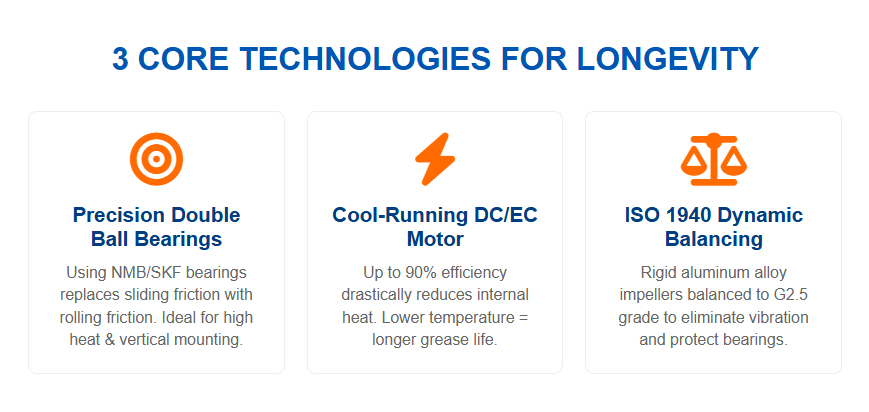
· Double Ball Bearings: For our long-life series, LONGWELL utilizes high-grade double ball bearings (often sourced from top-tier suppliers like NMB or SKF). These bearings use rolling elements to reduce friction significantly. They are less sensitive to temperature changes and can be mounted in any orientation (horizontal, vertical, or angled) without affecting lifespan. This is the standard for achieving crossflow fan lifespan hours exceeding 50,000.
2. Advanced EC and DC Motor Technology
The motor type dictates the internal heat generation.
· AC Motors: Traditional AC motors suffer from “slip” and higher electrical losses, which manifest as waste heat. This internal heat degrades the bearings from the inside out.
· DC/EC Motors: A DC crossflow fan (Direct Current) or EC (Electronically Commutated) fan operates with much higher efficiency (often up to 80-90%). Because they waste less energy, they run significantly cooler. A cooler motor means the bearing grease retains its viscosity for years longer than in an AC equivalent.
3. Dynamic Balancing and Impeller Rigidity
Vibration is the silent killer of fan bearings. Even microscopic imbalances in the impeller (the cylindrical blades of the cross flow fan) create wobble. Over millions of rotations, this wobble hammers the bearings, causing premature failure.
LONGWELL employs aluminum alloy impellers that are rigid and resistant to warping under heat. Every unit undergoes strict dynamic balancing tests to ISO 1940 standards (typically G2.5 or better). This ensures the fan spins concentrically, reducing load on the bearings and eliminating noise.
Brand Spotlight: Engineering Excellence
When selecting a partner for critical HVAC components, you need a manufacturer who understands the entire aerodynamic ecosystem.
About LONGWELL
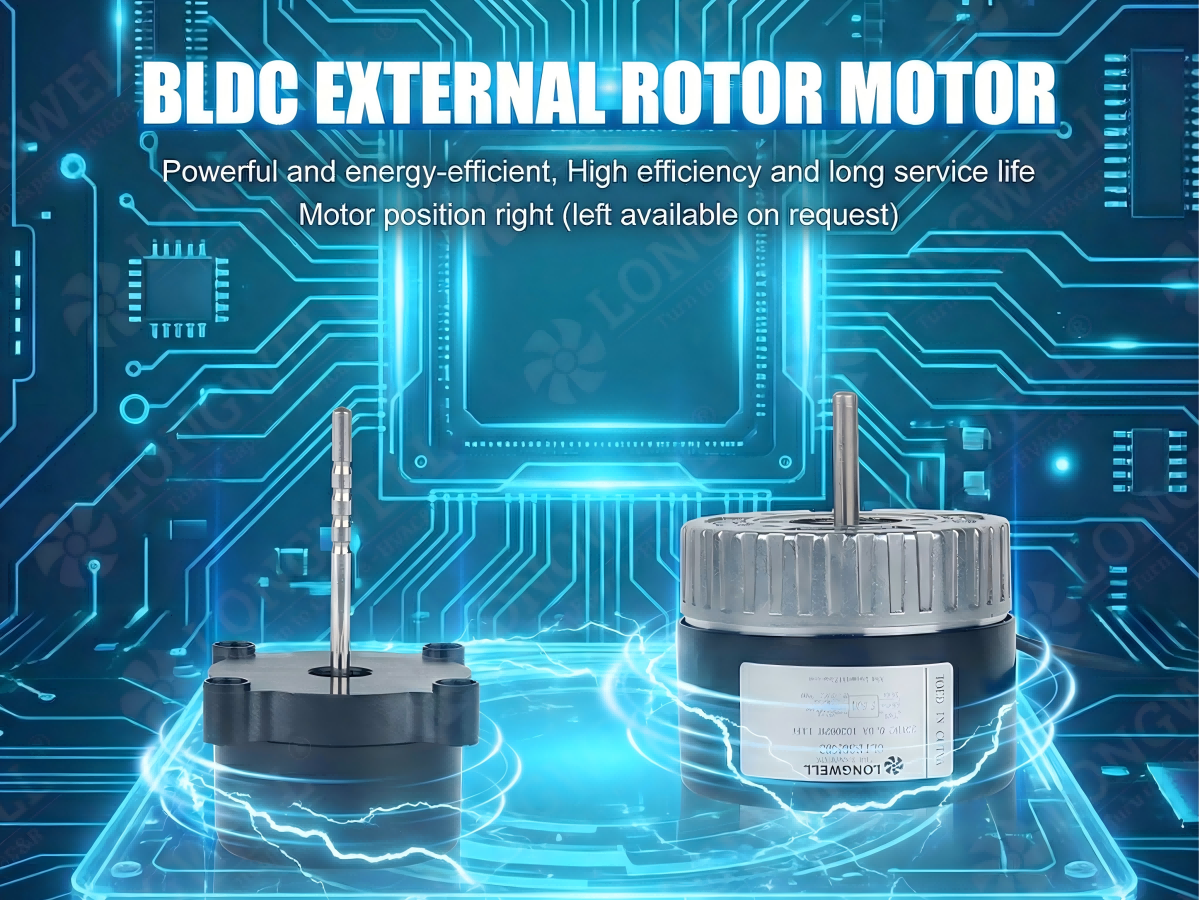
Ningbo Longwell Electric Technology Co., Ltd. (Website: www.longwellfans.com) is a professional manufacturer of HVAC fans and motors. We provide a full range of aerodynamic products including centrifugal fans, axial fans, cross-flow fans, and EC/DC/AC motors. Our products are widely used in HVAC, refrigeration and cold chain, electronic cooling, and industrial purification fields. With a commitment to quality and innovation, we engineer solutions that stand the test of time.
DC Crossflow Fan vs. AC Crossflow Fan: A Lifespan Comparison
If you are designing a system that requires a warranty of 5+ years, the choice between AC and DC becomes critical. While AC fans are simpler to connect directly to mains power, DC crossflow fans offer distinct advantages for longevity.
The “Cool Running” Advantage
As mentioned, DC motors control the winding current electronically. This precise control eliminates the hum and heat associated with AC frequency fluctuations. In a confined space, such as a trench heater or an under-floor convector, a DC fan contributes less heat to the environment, which is beneficial for both the system’s efficiency and the fan’s own survival.
Soft Start and Speed Control
A major stressor for fans is the “inrush current” and torque spike during startup.
· AC Fans: Typically switch on at full torque, jolting the mechanical components.
· DC/EC Fans: Feature “soft start” functions. The fan ramps up speed gradually. This reduces mechanical stress on the impeller and bearings during every start-stop cycle. Furthermore, 0-10V or PWM speed control allows the fan to run at partial speeds when full cooling isn’t needed, exponentially extending bearing life compared to running at 100% constant speed.
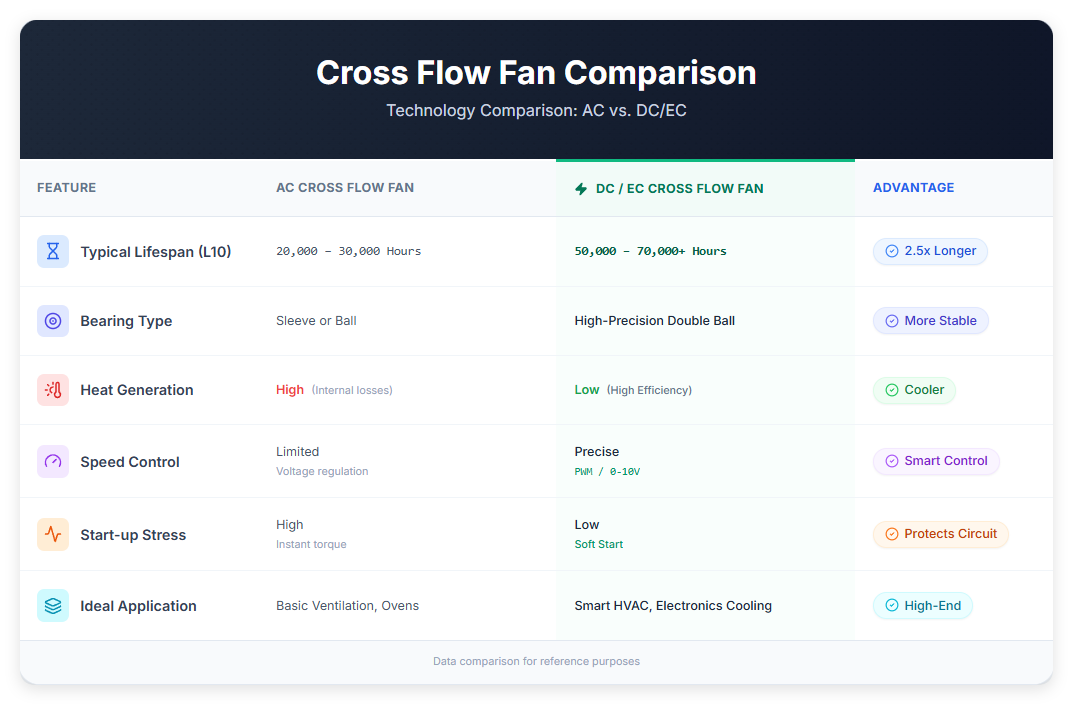
Table 1: Lifespan and Feature Comparison
|
Feature |
AC Cross Flow Fan |
DC / EC Cross Flow Fan |
|---|---|---|
|
Typical Lifespan (L10) |
20,000 – 30,000 Hours |
50,000 – 70,000+ Hours |
|
Bearing Type |
Sleeve or Ball |
High-Precision Double Ball |
|
Heat Generation |
High (Internal losses) |
Low (High Efficiency) |
|
Speed Control |
Limited (Voltage regulation) |
Precise (PWM / 0-10V) |
|
Start-up Stress |
High (Instant torque) |
Low (Soft Start) |
|
Ideal Application |
Basic Ventilation, Ovens |
Smart HVAC, Electronics Cooling |
For high-stakes applications, investing in a LONGWELL DC cross flow fan is often the most cost-effective decision over the total lifecycle of the product.
Key Factors That Shorten Fan Life (And How to Avoid Them)
Even the best crossflow fan for long life can fail prematurely if subjected to hostile conditions. Understanding these threats helps you design better enclosures and systems.
 1. Dust and Contaminant Ingress
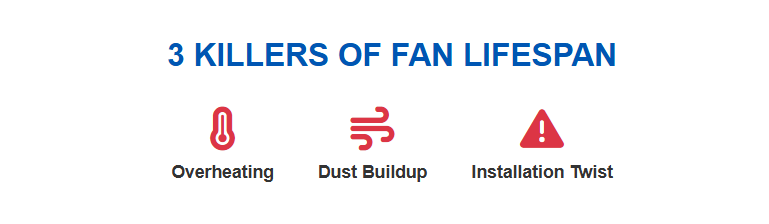
Cross flow fans typically have long, narrow impellers. If dust accumulates unevenly on the blades, it ruins the balance. This imbalance creates vibration, which destroys bearings. Additionally, conductive dust can short-circuit internal motor electronics if the fan isn’t rated with sufficient IP (Ingress Protection).
· Solution: Use filters on the intake side or select Longwell fans with upgraded IP ratings for harsh environments.
2. Improper Voltage and Power Quality
Fluctuating power supplies can cause motor windings to overheat. For DC fans, “dirty” power with spikes can damage the control electronics.
· Solution: Ensure stable power delivery. Longwell EC fans often come with built-in over-voltage and reverse-polarity protection to mitigate this.
3. Installation Stress
If a long cross flow fan (some span over 1 meter) is mounted on an uneven surface, the chassis can twist. This misalignment forces the shaft to grind against the bearings.
· Solution: Ensure the mounting surface is perfectly flat. Use rubber vibration isolators to prevent resonance transmission.
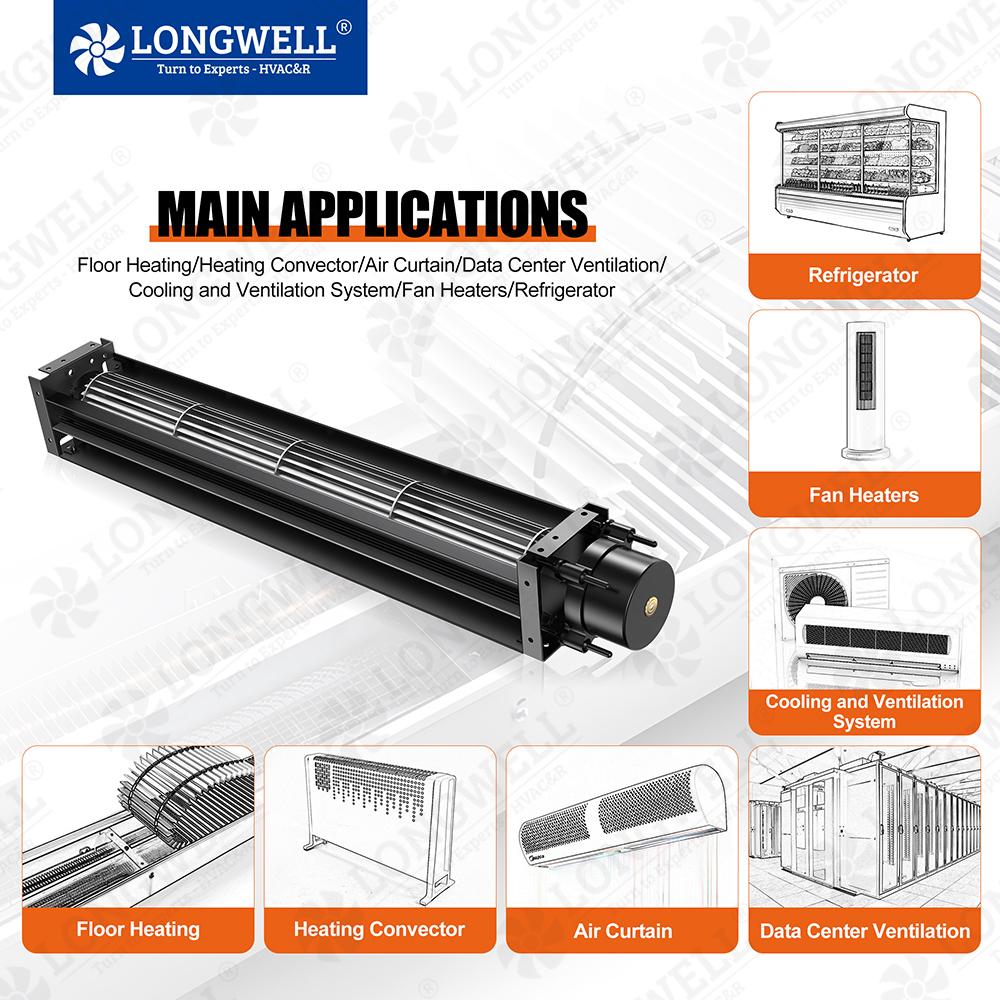
How to Extend Crossflow Fan Lifespan: Maintenance Checklist
While many modern EC fans are billed as “maintenance-free,” this term usually applies to the sealed bearings. The fan unit itself still requires care to reach that 50,000-hour milestone. Here is your actionable crossflow fan maintenance checklist:
Phase 1: Installation (The Foundation)
· Check Orientation: Verify the fan is mounted in an orientation permitted by the bearing type (Ball bearings = any angle; Sleeve = horizontal only).
· Voltage Verification: Ensure input voltage matches the label (e.g., 24V DC or 230V AC) to prevent immediate winding damage.
· Clearance: Leave sufficient space (at least 1/3 of the impeller diameter) on the intake and discharge sides to prevent back-pressure, which causes motor strain.
Phase 2: Routine Inspection (Every 6-12 Months)
· Clean the Impeller: Use compressed air or a soft brush to remove dust buildup from the blades. Do not use high-pressure water unless the fan is IP68 rated.
· Listen for Noise: A grinding or clicking sound usually indicates end-of-life for bearings. A humming sound might indicate electrical strain or debris.
· Vibration Check: Touch the housing. Excessive vibration suggests the impeller needs cleaning or the mounting screws have loosened.
· Check Connections: Ensure power and control wires (PWM/0-10V) are tight and free from corrosion.
Phase 3: Environmental Control
· Temperature Check: Ensure the ambient temperature is within the specified range (typically -20°C to +60°C). If the environment is hotter, consider adding auxiliary cooling or upgrading to a high-temp specific model.
By following these steps, you can significantly learn how to extend crossflow fan lifespan beyond the warranty period.
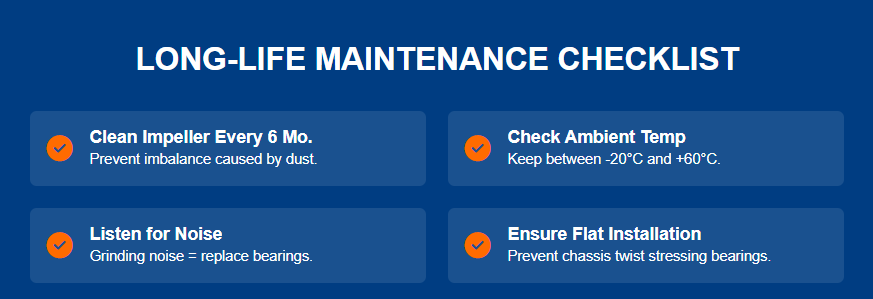
Applications That Demand 50,000+ Hours Reliability
Why is there such a push for these high-end specifications? In certain industries, maintenance is either impossible or prohibitively expensive.
1. Trench Heating and Floor Convectors
In high-end architectural projects, heating systems are buried in the floor. Accessing these fans requires lifting heavy grates or moving furniture. A failure here is a major inconvenience. Designers rely on LONGWELL cross flow fans because their low profile and high durability mean they can be installed and essentially forgotten for years.
2. Data Center and Server Cooling
Servers run 24/7/365. A fan failure can lead to thermal shutdown and data loss. Here, the reliability of a DC crossflow fan is critical for directing airflow over specific hot spots or rack components with absolute precision and zero downtime.
3. Medical and Laboratory Equipment
In devices like incubators or sterilization cabinets, airflow must be consistent. A fan that stops or fluctuates due to bearing wear can compromise biological samples. The stability of a high-quality motor is a safety requirement, not just a luxury.
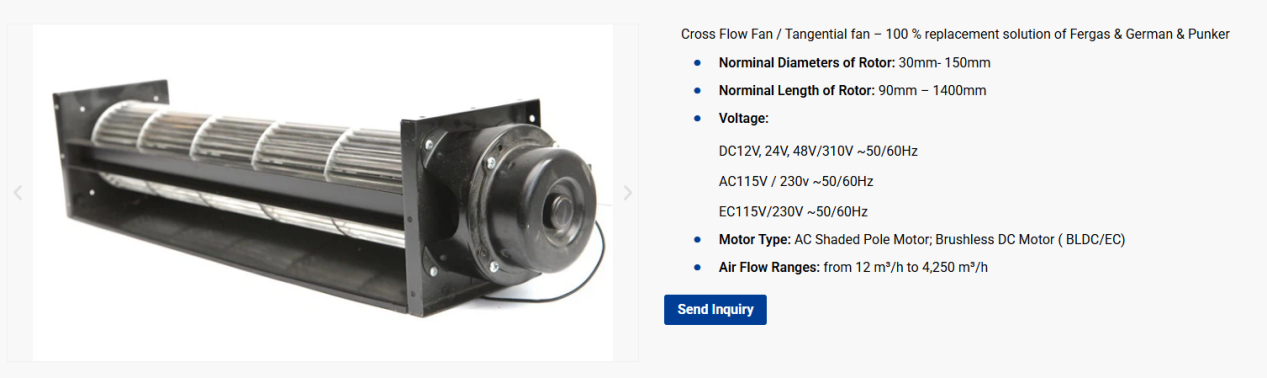
Choosing the Best Crossflow Fan for Your Project
When you are sourcing fans, how do you distinguish between a cheap generic copy and a professional-grade component? Here are three questions to ask your supplier:
1. “What is the L10 life rating, and at what temperature is it measured?” (Be wary if they cannot provide a temperature curve).
2. “What brand of bearings do you use?” (Look for NMB, SKF, or equivalent Japanese/German brands).
3. “Do you offer EC/DC options with speed control?” (This indicates modern manufacturing capabilities).
At LONGWELL, we don’t just sell fans; we co-develop solutions. If your application involves high humidity, extreme temperatures, or voltage fluctuations, our engineering team can customize the motor windings, insulation class, and materials to ensure the fan survives the environment.
Whether you need a compact 30mm diameter fan for electronics or a robust 150mm diameter unit for industrial air curtains, our portfolio covers the spectrum of HVAC needs.
Conclusion
A “long lifespan” is not a marketing buzzword—it is the result of deliberate engineering choices. By opting for a fan with double ball bearings, advanced DC motor technology, and a balanced aluminum impeller, you are investing in system stability.
A LONGWELL cross flow fan running for over 50,000 hours represents more than just durability; it represents 50,000 hours of peace of mind for you and your clients. Don’t let a $20 component jeopardize a $20,000 system. Choose reliability. Choose precision.
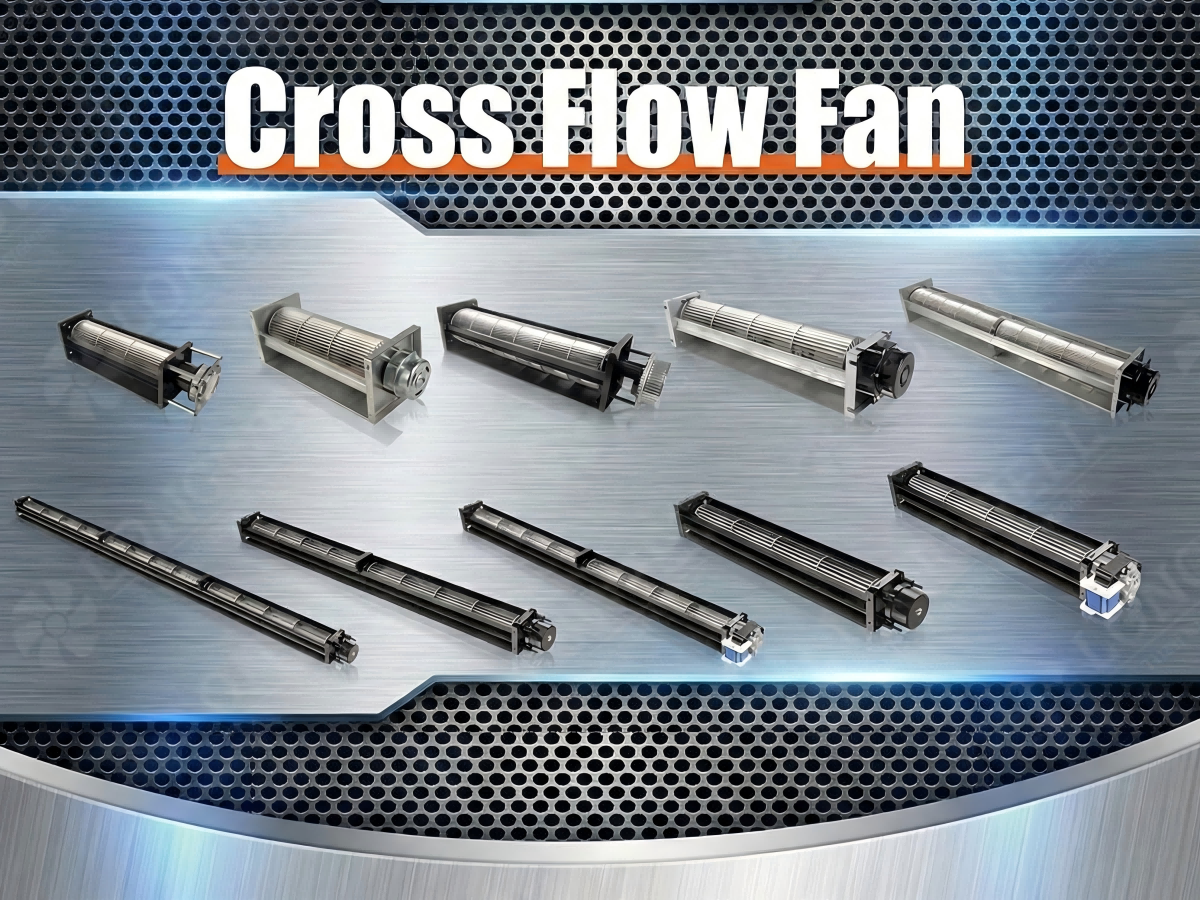
Ready to upgrade your ventilation system? Explore our range of high-performance Cross Flow Fans and contact our engineering team for a lifespan calculation based on your specific operating conditions.
FAQ: Common Questions About Cross Flow Fan Lifespan
Q1: What is the average lifespan of a standard cross flow fan?
A: A standard AC cross flow fan with sleeve bearings typically lasts between 15,000 to 30,000 hours. However, a high-quality DC crossflow fan with ball bearings, like those from Longwell, can exceed 50,000 to 70,000 hours under normal operating conditions.
Q2: How do I know if my cross flow fan bearings are failing?
A: The most common signs are increased noise (grinding or squealing), excessive vibration, or the fan failing to start immediately when power is applied. If the fan spins slowly or stops intermittently, the bearings are likely dried out or seized.
Q3: Can I extend the life of a sleeve bearing fan?
A: Generally, no. Sleeve bearings are sealed or oil-impregnated and are difficult to re-lubricate effectively. It is usually more cost-effective and reliable to replace it with a ball-bearing unit. To maximize its existing life, ensure it is mounted horizontally and kept free of dust.
Q4: Does running a fan at lower speeds increase its lifespan?
A: Yes, absolutely. Running a DC crossflow fan at 50% speed significantly reduces heat generation and mechanical wear on the bearings compared to running at 100% speed. This is a major advantage of using PWM or 0-10V speed control.
Q5: Why are DC fans considered better for long-life applications than AC fans?
A: DC fans operate with higher efficiency, meaning they generate less internal waste heat. Since heat is the primary factor that degrades bearing lubricant, the cooler operation of DC motors directly translates to a longer service life.
Q6: What is the maintenance schedule for a cross flow fan?
A: We recommend a visual inspection and cleaning every 6 months. Use a maintenance checklist to ensure the impeller is free of dust (which causes imbalance) and that the ambient temperature remains within the specified limits.