1. What is a Plug Fan?
If you have ever opened up the access door of an older Air Handling Unit (AHU), you know exactly what a “maintenance headache” looks like.
There is usually a fine layer of black rubber dust coating the floor panels—residue from wearing belts. The bulky scroll housing takes up nearly all the available space, making it difficult to reach the components. And chances are, you or your team have spent hours in there re-greasing bearings or tightening a slack belt drive.
It is messy, labor-intensive, and frankly, outdated.
Now, picture a modern setup. You open that same plenum door, but the space is clean. There is no housing, no belt drive, and no rubber dust. Instead, you see a compact fan wheel mounted directly on a motor, spinning silently and pressurizing the entire box evenly.
This is the Plug Fan—technically known as a Casingless Centrifugal Fan (or Plenum Fan).
In this guide, we are skipping the textbook fluff. We will break down exactly how Plug Fans work, why they are becoming the new standard for hygienic and efficient cooling, and how you can decide if they are right for your next project.
1.1 Introductions of Plug Fan
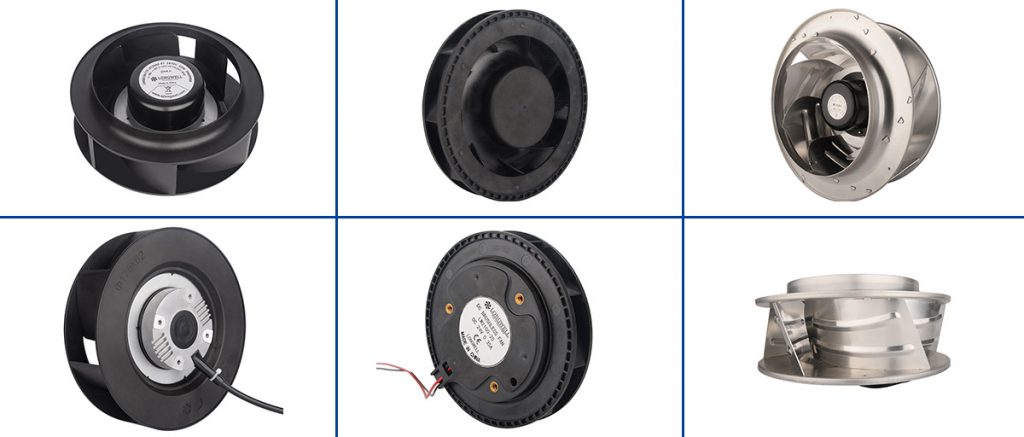
Plug fan, also known as a plenum fan, is a backward-curved centrifugal fan without a volute. Its compact design allows direct installation in static pressure chambers or ducts, making it easy to use and install, especially in confined and enclosed spaces.
Unlike fans that expel air through a volute, the airflow direction of plug fan is typically parallel to the motor shaft, drawing in air from one side and discharging it from the opposite, enabling efficient air handling, ventilation, and dust removal. It meet the ventilation and airflow requirements of spaces such as ovens, anechoic chambers, HVAC systems, clean rooms, and drying systems.
1.2 What are the Core Components of Plug Fan?
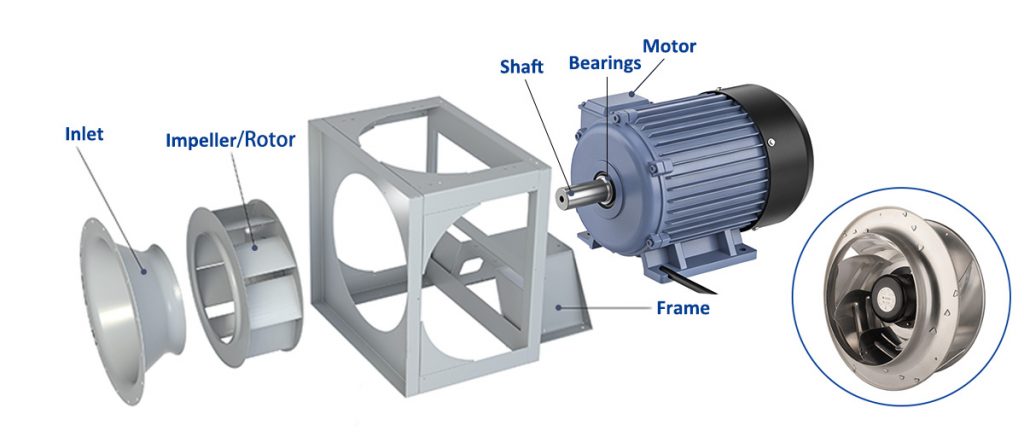
- Impeller/Rotor: The impeller is the heart of the operation, we almost exclusively utilize backward-curved centrifugal wheels made from high-strength aluminum or composite materials. This minimizes rotational inertia for faster response times and reduced vibration.
- Motor: The motor in a modern plug fan is almost exclusively direct-drive, meaning the days of maintaining belts and pulleys are effectively over. These “smart” motors offer built-in variable speed control without external VFDs, running significantly cooler and quieter while maintaining peak efficiency even when operating at partial speeds.
- Bearings: In Longwell EC models, these high-precision bearings are typically sealed and permanently lubricated within the motor housing, providing a virtually maintenance-free operation lifespan that often exceeds 40,000 hours.
- Frame: With “casingless” design, the frame allows the impeller to discharge air radially in 360°, utilizing the walls of your Air Handling Unit (AHU) itself as the pressurization chamber, which saves massive amounts of space.
- Inlet: The inlet cone is a precision-engineered funnel that smoothly guides air into the eye of the spinning impeller, ensuring laminar flow and reducing noise-causing turbulence.
- Shaft: In the compact structure of the plug-in fan, its shaft is typically directly integrated with the motor rotor, ensuring that the motor’s maximum power is directly converted into aerodynamic power for the wheels.
1.3 Why is the Plug Fan Important to You?
The key innovation of the plug-in fan lies in its shell-less design. Compared with the bulky traditional shell-type fan, it is more compact and can directly utilize the air handling unit (AHU) housing as a pressurization chamber.
- Space-saving Solution: When limited installation space prevents accommodating large volute structures or complex piping systems, Plug Fan is the optimal choice.
- Easy Maintenance and Cleaning: Its direct drive design eliminates dust from belt wear and ensures no hygiene dead zones, making it ideal for hospitals and data centers with stringent cleanliness requirements.
- High-efficiency and Flexible: Despite the removal of the volute, it delivers robust static pressure through its high-efficiency backward centrifugal impeller. More importantly, it enables multiple fans to be connected in parallel to form a “fan wall,” achieving system redundancy—a capability unattainable with traditional fans.
2. How Does a Plug Fan Work?
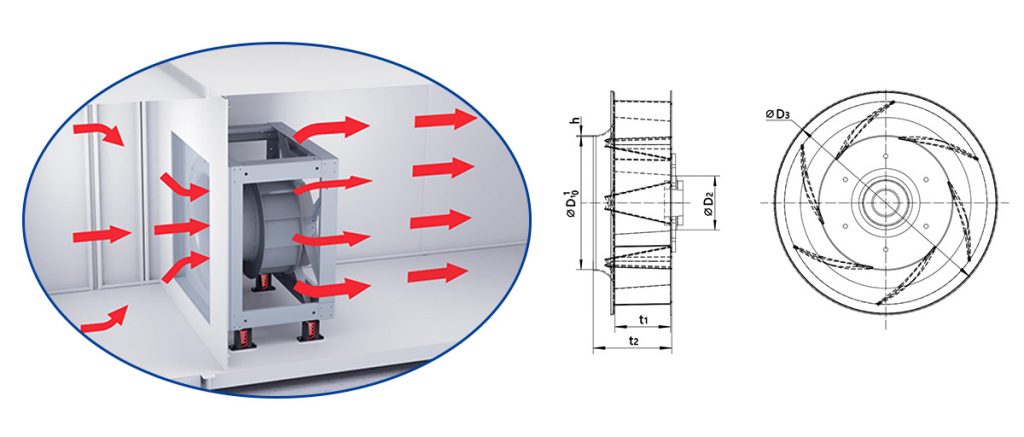
A Plug Fan operates on a distinct principle known as “plenum pressurization.” Unlike traditional fans that force air through a restrictive scroll housing, a plug fan features a free-spinning, backward-curved impeller.
It draws air in axially (straight through the front inlet cone) and accelerates it, discharging the airflow radially in a 360° pattern. This “casingless” design allows the air to expand freely as it leaves the wheel blades.
Once the air is discharged, it fills the surrounding cabinet—or plenum—converting high-velocity kinetic energy into stable static pressure. Instead of blasting air at a single point, the pressurized plenum pushes air evenly through the entire duct system.
This ensures uniform airflow distribution across filters and heat exchangers, eliminating the turbulent “dead zones” often caused by the focused blast of standard housed fans.
3. Top 5 Advantages of Using Plug Fans
Plug fan offers multiple benefits. Here are the top 5 advantages to help you better understand how it boosts productivity and save energy.
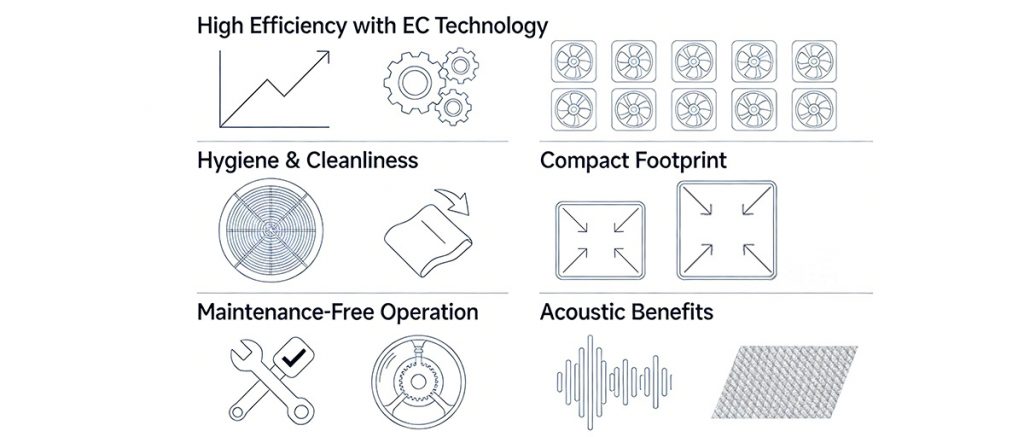
3.1 High Efficiency with EC Technology
Unlike traditional fans that operate in just two states—on or off—EC Plug Fan works differently. It helps you save every kilowatt-hour of electricity through 4 key features:
- A breakthrough in motor technology: The core utilizes high-efficiency EC motors with advanced electronic rectification technology, effectively reducing heat loss and energy waste at the source.
- Precision stepless speed control: It operates like a variable-frequency air conditioner, precisely adjusting the speed based on actual ventilation needs. The system consumes only the amount of electricity required, minimizing energy waste during operation.
- Outstanding performance under partial load: In most HVAC systems where full-load operation is unnecessary (partial load), EC fans demonstrate the most significant energy efficiency advantages, effectively reducing power consumption at low speeds.
- The synergistic fusion effect of fan wall integration: When multiple EC fans are combined into a ‘Fan Wall’, the airflow distribution becomes more uniform and system resistance is reduced, not only optimizing performance but also elevating overall energy efficiency to new heights.
3.2 Hygiene & Cleanliness
With unique structural advantages, the plug fan meets stringent hygiene standards including DIN 1946-4 and VDI 6022, making it the preferred ventilation solution for highly sensitive applications.
- Zero Particulate Emission: Thanks to Direct Drive Construction, this fan eliminates drive belts and pulley assemblies. This not only avoids airflow contamination from rubber particles generated by belt friction but also eliminates maintenance needs caused by belt slack, ensuring the highest level of cleanliness in the delivered air.
- Cleanability & Accessibility: Traditional volute fans have hard-to-clean dust accumulation blind spots inside. In contrast, the Plug Fan uses the Open Plenum principle. The impeller and its mounting panel are fully exposed within the maintenance space, with a smooth surface and no complex geometric dead angles. This allows maintenance personnel to thoroughly clean and sanitize the unit, effectively preventing microbial growth and meeting the requirements of the HACCP food safety management system.
3.3 Compact Footprint
Traditional centrifugal fans, with their bulky scroll housings, often occupy significant space in air handling units (AHUs). The 90° angle between the inlet and outlet restricts the flexibility of duct design.
Plug fan utilizes a de-coffered design that directly incorporates the AHU enclosure as a pressurization chamber. This innovative approach dramatically reduces the fan section length, resulting in a more compact unit that saves valuable space in your server room.
3.4 Maintenance-Free Operation
If you’re tired of constantly replacing belts, adjusting tension wheels, and cleaning up black powder from wear, Plug fan is your ultimate solution.
- Direct Drive Technology: The impeller is directly mounted on the motor shaft, eliminating wear-prone components like belts, pulleys, or bearing housings. This enables near-maintenance-free operation, completely eliminating the risk of unexpected shutdowns caused by belt breakage.
- Easy Access: The fan is housed in a spacious static pressure chamber with a shell-less design. Maintenance personnel can directly access the impeller, motor, and chamber walls after opening the inspection door. This eliminates blind spots during routine inspections or high-sterility deep wash-down, significantly reducing operational labor costs.
3.5 Acoustic Benefits
Contrary to popular belief, the absence of a volute casing doesn’t increase noise levels. Plug fan utilizes a plenum as a natural sound-absorbing device.
- Reducing Outlet Wind Speed: Traditional fans emit high-speed airflow through a narrow volute outlet, generating sharp turbulent noise. In contrast, the Plug Fan disperses airflow 360°, significantly reducing outlet wind speed and thereby minimizing high-frequency aerodynamic noise.
- Enhanced Sound Insulation: When sound propagates and reflects within the anechoic chamber, the sound-absorbing materials on the chamber walls effectively absorb it. Particularly for the persistent issue of low-frequency noise, the Plug fan’s spectral characteristics are better suited for attenuation through the AHU panel. As a result, under the same airflow conditions, the Plug Fan typically operates with lower overall noise levels, providing a more comfortable listening experience.
4. Applications: Where are Plug Fans Used?
You might be surprised to find that plug fans are taking over spaces previously dominated by massive housed fans. It’s not just a trend; it’s a shift toward modularity. Here is where they are making the biggest impact:

4.1 AHU Retrofits
This is arguably the top application for plug fans today. Old Air Handling Units (AHUs) often house massive, belt-driven centrifugal fans that are nearing the end of their life. These units are heavy, vibrate excessively, and are coated in rubber dust.
- The Solution: Instead of ripping out the entire AHU (which is expensive and disruptive), engineers simply remove the old fan and “plug in” a new, compact EC Plug Fan.
- The Benefit: You get a brand-new, high-efficiency system within the existing footprint, often completed over a single weekend with zero structural changes.
4.2 Data Centers
When you are cooling millions of dollars worth of servers, you don’t rely on a single point of failure. You build a Fan Wall. Instead of one giant fan, you stack multiple plug fans in a grid.
If one motor burns out, the others automatically speed up to pick up the slack. Your servers stay cool, your uptime stays at 100%, and you sleep better at night. Plus, the smaller footprint gives you more room for actual server racks.
4.3 Clean Rooms / Hospitals
In sterile environments, what you can’t see can hurt you. Traditional housed fans have dark corners inside the scroll that trap moisture—a perfect hotel for mold and bacteria.
With a plug fan, everything is out in the open. You can see the impeller, the motor, and the backplate. When it’s time for sanitation, your team can wash down the entire unit easily. No hidden dust, no belt residue, just clean air.
4.4 Industrial Ventilation
Sometimes you just need raw power. Whether you are drying paint, curing food, or pushing air through dense industrial filters, plug fans handle the high static pressure without the headache of maintaining belts and pulleys in a dirty factory environment. Just plug it in and let it run.
5. What Is the Difference Between Centrifugal Fan and Plug Fan
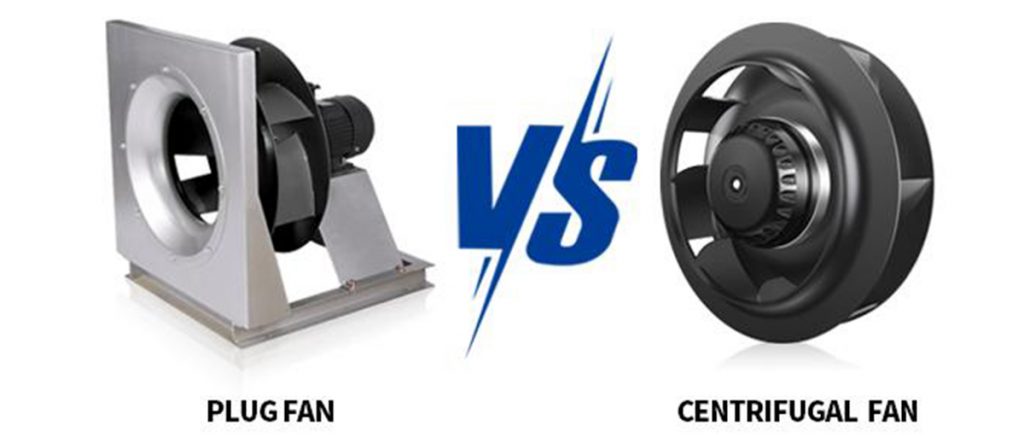
Still on the fence? You might be asking, “Why change what works?”While the traditional housed fan had its glory days, the modern plug fan outperforms it in almost every metric that matters to a facility manager today. Let’s look at the hard facts:
Feature | Traditional Housed Fan (The Old Guard) | Plug Fan / Plenum Fan (The Modern Choice) |
Space Required | Bulky. The scroll housing and motor base eat up huge amounts of AHU real estate. | Compact. Saves up to 40% of space. You use the AHU cabinet itself as the housing. |
Hygiene | Dirty. Belts generate black rubber dust. Internal scrolls are hard to clean. | Clean. Direct drive means no dust. The open design allows for easy wash-downs. |
Maintenance | High. You are stuck greasing bearings, aligning pulleys, and changing belts. | Zero to Low. No belts, no pulleys. Just a motor and a wheel. |
Flexibility | Rigid. Discharge angle is fixed (usually 90°). Hard to modify. | Versatile. 360° radial discharge. Perfect for building Fan Walls. |
Efficiency | Losses. Friction from belts reduces overall system efficiency. | High. Direct transmission of power plus EC motor technology equals lower energy bills. |
6. How to Select the Right Plug Fan?
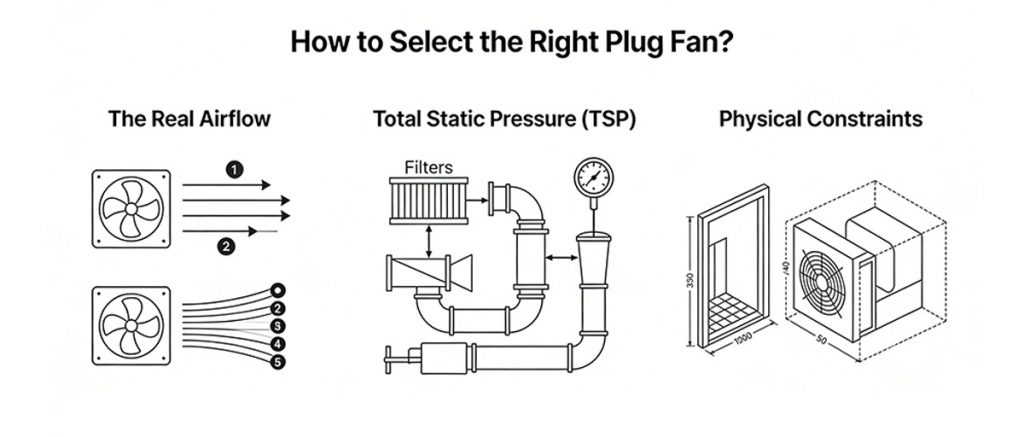
Selecting a plug fan isn’t as simple as just “matching the horsepower.” Since there is no housing, the performance depends heavily on where you put it.
To get a quote that actually works for your system, you need to nail down these three specs:
- The Real Airflow
Don’t just copy the number from the old fan’s nameplate. That old fan might have been oversized (wasting energy) or undersized. What does your system need right now? Be precise.
- Total Static Pressure (TSP)
This is where most people mess up. Because a plug fan pressurizes the plenum, you must account for the resistance of everything in the airflow path: filters, coils, dampers, and ductwork. If you underestimate the static pressure, your fan will spin, but the air won’t go anywhere.
- Physical Constraints
Are you building a new box or retrofitting an old one?
For Retrofits: Measure the doorframe. The best fan in the world is useless if you can’t get it into the room.
For Performance: Measure the plenum size. Plug fans need a bit of “breathing room” around the wheel to build pressure efficiently. If the box is too tight, performance drops.
Ready to spec your fan? Don’t struggle with the calculations alone. Click Here to send us your Airflow, Pressure, and Space dimensions, and Longwell engineers will run a simulation to find your perfect match.